
How Is Autism Diagnosed? A Parent-Friendly Guide
If you’ve ever wondered whether your child’s development is on track—or if you’ve noticed behaviors that seem different from other children—you may have asked yourself: Could this be autism?
Getting an autism diagnosis can feel overwhelming, but understanding the process can help make it less intimidating. The good news is that early identification can lead to earlier support, and that can make a big difference.
What Is Autism?
Autism Spectrum Disorder (ASD) is a developmental condition that affects how a person communicates, interacts socially, and experiences the world around them. Autism is called a “spectrum” because it looks different in every child.
Some children may have strong verbal skills but struggle socially, while others may have delayed speech, sensory sensitivities, or repetitive behaviors.
What Are the Early Signs of Autism?
Parents are often the first to notice when something feels different. Some common early signs may include:
- Limited eye contact
- Delayed speech or language development
- Not responding to their name consistently
- Repetitive movements like hand flapping or rocking
- Strong reactions to sounds, textures, or lights
- Difficulty with transitions or changes in routine
- Limited interest in playing with others
- Intense focus on specific topics or objects
It’s important to remember: having one or two of these traits does not automatically mean a child has autism.
At What Age Can Autism Be Diagnosed?
Autism can sometimes be identified as early as 18 months, though many children are diagnosed later.
Some signs become more noticeable when children start preschool or enter social settings where communication and interaction expectations increase.
The earlier autism is identified, the sooner support can begin.
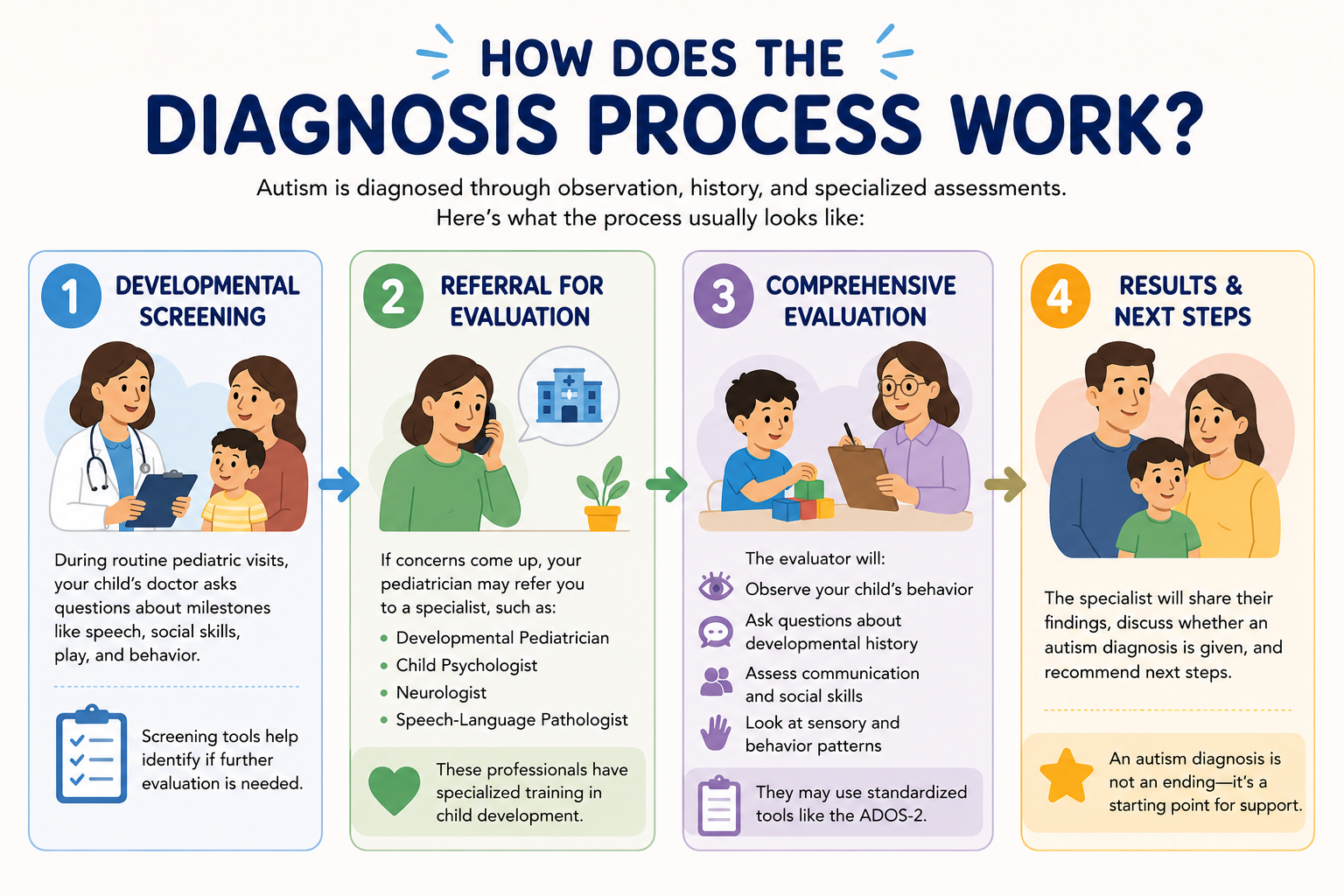
How Does the Diagnosis Process Work?
Autism is not diagnosed through a blood test, brain scan, or lab work. Instead, it’s diagnosed through observation, developmental history, and formal assessments.
Here’s what the process usually looks like:
- Developmental Screening
During routine pediatric visits, your child’s doctor may ask questions about milestones like:
- Speech development
- Social interaction
- Play skills
- Behavior
Many pediatricians use screening tools to identify developmental concerns.
- Referral for Evaluation
If concerns come up, your pediatrician may refer you to a specialist, such as:
- A developmental pediatrician
- A child psychologist
- A neurologist
- A speech-language pathologist
These professionals have specialized training in child development.
- Comprehensive Evaluation
This is the most detailed step. The evaluator will typically:
- Observe your child’s behavior
- Ask questions about developmental history
- Assess communication skills
- Evaluate social interaction
- Look at sensory and behavioral patterns
They may use standardized tools like the Autism Diagnostic Observation Schedule (ADOS).
What Happens After a Diagnosis?
An autism diagnosis is not an ending—it’s a starting point.
Once diagnosed, families can access services like:
- Applied Behavior Analysis (ABA therapy)
- Speech therapy
- Occupational therapy
- Social skills training
- School support services
Early intervention can help children build communication, social, and daily living skills.
What If My Child Is Diagnosed?
It’s normal to feel a mix of emotions—relief, fear, confusion, or uncertainty.
Many parents worry about what the future will look like. But autism does not define your child’s potential.
With the right support, many autistic children thrive, grow, and develop meaningful independence.
Trust Your Instincts
If you have concerns about your child’s development, trust yourself.
You do not have to “wait and see” if something feels off. Asking questions early can provide clarity and open doors to support.
The sooner you seek answers, the sooner your child can get the help they may need. The autism diagnosis process can feel like a lot, but you don’t have to navigate it alone. Whether you’re just starting to ask questions or are ready to seek services, taking that first step matters.
Every child develops differently—and every child deserves the opportunity to reach their full potential.