
Autism vs. ADHD
As a parent, noticing differences in your child’s behavior, communication, attention, or learning style can bring up many questions. You may wonder: Is this autism? Is this ADHD? Could it be both?
Autism Spectrum Disorder (ASD) and Attention-Deficit/Hyperactivity Disorder (ADHD) are both neurodevelopmental conditions that begin in childhood and can impact learning, behavior, relationships, and everyday activities. Because they share some similar characteristics, it can sometimes be difficult for families to understand the differences.
While autism and ADHD are separate diagnoses, a child can have both conditions. Understanding the similarities and differences can help families seek the right evaluation, resources, and support.
What Is Autism?
Autism Spectrum Disorder (ASD) is a developmental condition that affects communication, social interaction, and how individuals experience the world around them.
Because autism is a spectrum, every child’s experience is different. Some children may need significant support, while others may need fewer supports and develop strong independence.
Common characteristics of autism may include:
- Differences in communication styles
- Difficulty understanding social cues
- Preference for routines and consistency
- Repetitive movements or behaviors
- Strong interests in specific topics or activities
- Sensory sensitivities to sounds, textures, lights, or environments
Children with autism also have many strengths, including creativity, problem-solving skills, attention to detail, and unique ways of thinking.
What Is ADHD?
Attention-Deficit/Hyperactivity Disorder (ADHD) is a neurodevelopmental condition that affects attention regulation, impulse control, and activity levels.
Children with ADHD may experience challenges such as:
- Difficulty staying focused on tasks
- Frequently losing items
- Trouble completing multi-step directions
- Acting before thinking
- Interrupting conversations
- Difficulty sitting still
- Challenges with organization and time management
ADHD can present differently from child to child. Some children primarily struggle with attention, while others experience more hyperactivity and impulsivity.
At a Glance
| Autism Spectrum Disorder (ASD) | ADHD |
|---|---|
| Differences in social communication and interaction | Challenges with attention and impulse control |
| May prefer routines and predictability | May seek novelty and stimulation |
| Repetitive behaviors or focused interests may occur | Hyperactivity and impulsive behaviors may occur |
| Sensory sensitivities are common | Difficulty with organization and staying focused |
| May have difficulty interpreting social cues | May interrupt or act before thinking |
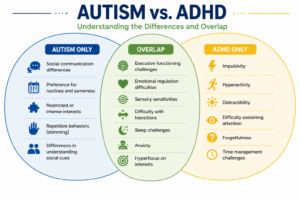
Similarities Between Autism and ADHD
Although autism and ADHD are different diagnoses, they can share several characteristics.
Children with either condition may experience:
- Difficulty with transitions
- Emotional regulation challenges
- Sensory sensitivities
- Executive functioning difficulties
- Challenges in school settings
- Trouble with social interactions
- Strong interests or areas of focus
Because of these similarities, a professional evaluation is important. A child’s behaviors should be looked at as a whole rather than based on one or two characteristics.
Key Differences Between Autism and ADHD
Social Skills
Autism:
Children with autism may have difficulty understanding social cues, interpreting facial expressions, or knowing how to respond in certain social situations.
ADHD:
Children with ADHD often understand social expectations but may interrupt, miss details, or act impulsively because of challenges with self-control.
Attention and Focus
Autism:
A child may become deeply focused on a preferred interest and have difficulty shifting attention away from it.
ADHD:
A child may struggle to maintain attention, especially during tasks that are not highly motivating or interesting.
Routines and Change
Autism:
Many children with autism prefer predictability and may feel overwhelmed by unexpected changes.
ADHD:
Children with ADHD may enjoy new experiences but may struggle with maintaining routines, organization, and consistency.
Can a Child Have Both Autism and ADHD?
Yes. Some children are diagnosed with both autism and ADHD.
When both conditions are present, a child may experience challenges related to communication, social skills, attention, impulse control, and emotional regulation.
A comprehensive evaluation can help families understand their child’s individual strengths and challenges and determine which supports may be beneficial.
When Should Parents Consider an Evaluation?
Parents may want to speak with their child’s pediatrician or a developmental professional if they notice ongoing challenges such as:
- Delayed communication or social development
- Difficulty interacting with peers
- Significant attention or behavior concerns
- Strong sensory sensitivities
- Difficulty adjusting to changes
- Challenges that affect school, home, or daily activities
Early identification can help families access resources and support that encourage growth and independence.
How ABA Therapy Supports Children with Autism
Applied Behavior Analysis (ABA) therapy is an evidence-based treatment commonly used to support children with Autism Spectrum Disorder.
ABA focuses on understanding behavior and teaching meaningful skills that improve everyday life, including:
- Communication
- Social skills
- Independence
- Daily living skills
- Play skills
- School readiness
- Emotional regulation
While many behavioral strategies used in ABA can be helpful for children with a variety of developmental needs, ABA therapy is generally not covered by insurance for ADHD alone. Most insurance plans require an autism diagnosis and medical necessity criteria for ABA coverage.
For children diagnosed with both autism and ADHD, ABA therapy may address individualized goals related to communication, behavior, independence, and self-regulation as part of a comprehensive treatment plan.
At The Buddy Center, our team creates individualized ABA programs designed around each child’s unique strengths, needs, and goals.
Helpful Resources for Families
For additional information about autism and ADHD, visit: