Many parents still hear the term Asperger’s and wonder how it differs from autism. Is Asperger’s still a diagnosis? Is it “milder” autism? And how do autism levels fit into all of this?
The short answer: Asperger’s is now considered part of Autism Spectrum Disorder (ASD)—but the language people use hasn’t fully caught up yet. Let’s break it down in a clear, practical way.
What Was Asperger’s?
Asperger’s syndrome was once a separate diagnosis used to describe individuals who:
- Had strong verbal and cognitive skills
- Showed social communication challenges
- Had restricted interests or repetitive behaviors
- Did not have significant language delays
People often referred to Asperger’s as “high-functioning autism,” though this term is no longer clinically recommended.
What Changed?
In 2013, the DSM-5 (Diagnostic and Statistical Manual of Mental Disorders) removed Asperger’s as a standalone diagnosis. Instead, it became part of a single diagnosis:
Autism Spectrum Disorder (ASD)
This change happened because research showed that autism traits exist on a spectrum, not in neatly separated categories.
Today:
- Someone previously diagnosed with Asperger’s would now be diagnosed with Autism Spectrum Disorder
- Their support needs would be described using autism levels
What Does “Autism Spectrum” Mean?
The autism spectrum refers to the range of support needs, not a straight line from “less” to “more” autistic.
Autism affects:
- Communication
- Social interaction
- Sensory processing
- Behavior and routines
Each autistic person has a unique combination of strengths and challenges.
Autism Levels Explained
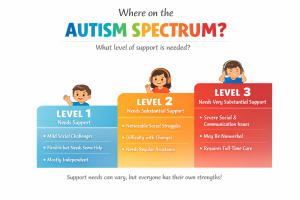
Under the DSM-5, Autism Spectrum Disorder is categorized into three levels, based on how much support a person needs in daily life.
Autism Level 1 – Requiring Support
Often associated with what people used to call Asperger’s.
Common traits may include:
- Strong language skills but difficulty with social nuance
- Trouble with flexibility, transitions, or change
- Sensory sensitivities
- Challenges with organization or emotional regulation
Individuals at Level 1 may appear independent but still benefit from structured support, therapy, or accommodations.
Autism Level 2 – Requiring Substantial Support
Common traits may include:
- Noticeable communication challenges
- Difficulty initiating or maintaining social interactions
- More frequent repetitive behaviors or sensory needs
- Struggles with daily living skills
Support often includes consistent therapy, visual supports, and structured routines.
Autism Level 3 – Requiring Very Substantial Support
Common traits may include:
- Limited verbal communication or nonverbal communication
- Significant difficulty with change or transitions
- Intense sensory sensitivities
- High support needs for daily living and safety
Individuals at Level 3 typically require comprehensive, ongoing support across environments.
Why Some People Still Say “Asperger’s”
Even though it’s no longer a medical diagnosis, people may still use the term Asperger’s because:
- They were diagnosed before 2013
- It feels less stigmatizing to them
- It helps describe their experience more clearly in conversation
Clinically, however, the correct term today is Autism Spectrum Disorder, with a specified support level.